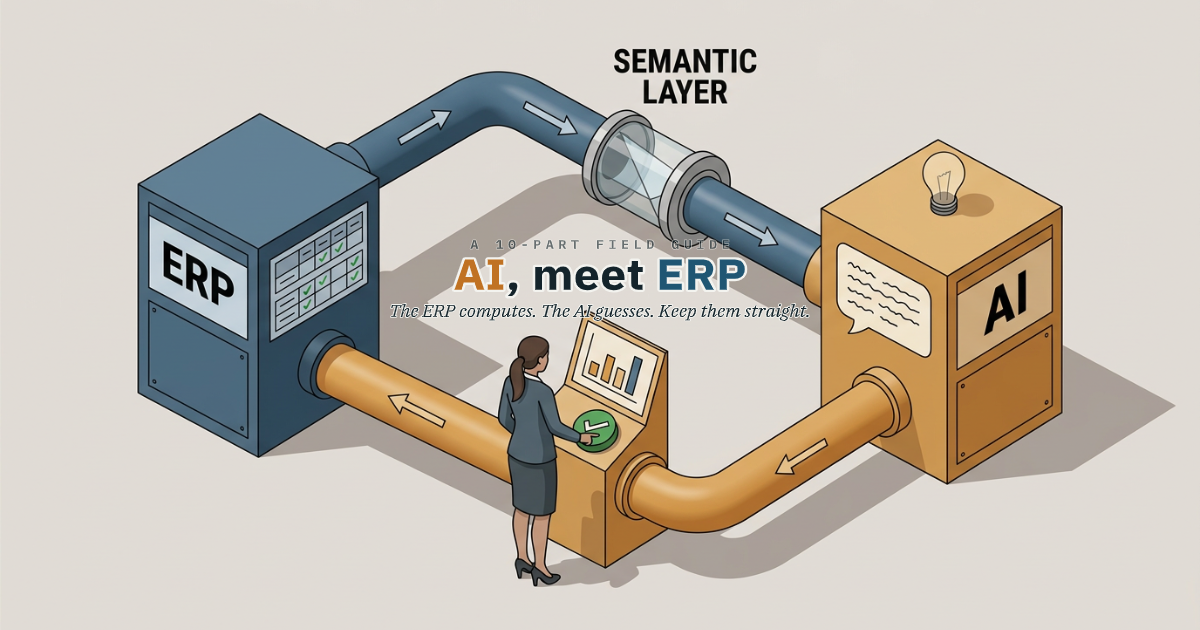
AI, Meet ERP
Keep your system of record and your system of inference as two separate machines. Engineer the boundary between them.
Most AI-in-ERP projects fail by asking one machine to do another's job. Your ERP is a system of record – deterministic, arithmetic, auditable. A large language model is a system of inference – fast, linguistic, and wrong quietly. This series keeps them apart and engineers the boundary between them, one real manufacturing workflow at a time, with every number computed from a published, sourced model company. New post every week.
Here is how we make that concrete.
The series follows one fictional company – Spiese Fluid Power, an $85M hydraulic-power manufacturer that also distributes – through ten real workflows. Spiese is a composite, but it is not made up: every figure we publish about it is computed from a single published set of operating assumptions, each one sourced to a public benchmark or flagged as a stated choice you should replace with your own. A series arguing that arithmetic belongs to the system of record should not run on invented numbers, so it doesn't.
Each post works a single problem all the way through the same spine: what it costs today, where the boundary sits, what the AI does and what it must never do, how you would know it worked, and the smallest version you could start on Monday.
We should be plain about our own position. HarrisData is family-owned, with no outside investors to impress – so when the honest answer is "this technology isn't worth buying yet," we can say so. Our own ERP, like most of our customers, runs on the IBM midrange; where a post notes that something is easier there, that is our home turf talking, and we have kept the advice itself platform-neutral.
One more disclosure, and a fitting one for a series about using AI well: we used AI to help make it – as a research assistant, an editor, a graphics consultant, a fact-checker, a plagiarism checker, a consistency checker, and more. But the ideas are ours, the words are ours, and the responsibility for publishing them is ours. That is the boundary this series argues for, applied to the series itself: the machine reads, drafts, checks, and explains; the people decide what is true, and answer for it.

Post #2: AI, Meet ERP
Part 1 of 10 - Means before ends
Published September 4th, 2026
by Lane Nelson
AI promises to transform the way we do business. The difference between an AI initiative that delivers and one that disappoints may come down to a question few companies are asking.
Posts

September 4th, 2026
Author: Lane Nelson
Approx. 10 minute read
An ERP is a system of record – deterministic, arithmetic, auditable. A large language model is a system of inference – probabilistic, linguistic, fast, and wrong quietly. They are two different machines, and the value is in the handoff between them, not in merging them. Gartner expects more than 40% of agentic-AI projects to be cancelled by end of 2027; most fail by asking one machine to do the other's job.

September 15th, 2026
Approx. 8 minute read
Before reaching for AI, ask two questions: is the input structured, and is the logic stable? If both are yes, you don't have an AI project – you have a business rule you haven't written yet. A rule is cheaper, faster, auditable, and cannot hallucinate. Much of what gets pitched as an "AI opportunity" is really a backlog of integrations in disguise.

September 22nd, 2026
Approx. 4 minute read
Inbound customer POs that arrive as email PDFs are the most automatable task on a manufacturer's order desk – and the most expensive to get slightly wrong. Let the LLM read the document and draft the order; let the ERP compute price, availability, and credit; let a human approve the exceptions. The lever is accuracy, not speed – the human-review step is the product, not a training wheel you remove later.
Approx. 7 minute read

September 29th, 2026
When a long-tenured planner retires, the ERP still knows what is true – but the why walks out the door. Capture it first (record an exit interview; index the tickets and procedures), then put a read-only retrieval layer over it that cites every answer and never writes to the ERP. It's the safest first AI project because it has no write path – the worst a wrong answer can do is mislead a human still in the loop.
Approx. 9 minute read

October 6th, 2026
Pointing an LLM at your raw ERP tables to "chat with your data" fails silently – it returns plausible wrong numbers, not error messages. A 2026 dbt Labs benchmark found models answered 64.5% of raw-schema questions correctly, but 100% when routed through a governed semantic layer. Build the semantic layer first; put natural language on top.
Approx. 8 minute read

October 13th, 2026
MRP already tells you the truth every night – about 370 action messages a day at a mid-sized manufacturer, most of them noise that resolves itself. Planners stop reading, and the six that matter get buried. Don't touch the MRP math; use an LLM to triage its output – rank, cluster, and explain which few need a human today – while every reschedule still flows back through the ERP, committed by a person.
Approx. 8 minute read

October 13th, 2026
Three-way match – purchase order, goods receipt, supplier invoice – is where money leaks, because the invoice that almost matches gets paid. Let the system of inference read the messy invoice and match its lines against the PO and receipt the system of record already holds; let a human approve every exception. The AI reads and matches, the ERP holds the numbers, and nothing gets paid without the record's say-so.
Resources

September 4th, 2026
Author: Lane Nelson
Spiese Fluid Power is fictional – a composite mid-market manufacturer used throughout this series so that every claim we make can be checked. This page is the audit trail behind it.
AI, Meet ERP is a blog series published by HarrisData. For more information contact HarrisData.
© 2026 Harris Business Group, Inc. All rights reserved.